

Spider Mites on Plants: How to Spot, Stop, & Prevent an Infestation
Plants are fun to own, but keeping them alive requires special care, and of course, you need to prepare for that when you buy a new one. Most people know that when you buy a plant, you’ll need nutrient-rich soil, water, sunlight, and the right size pot or plot for it to keep growing.
However, some newer plant owners aren’t prepared to find bugs in their store-bought plants, which is often a given when plants are kept close together in stores. One of the most common pests found in store-bought plants is spider mites, which are a destructive nuisance. In this blog, we explain how to spot, stop, and prevent infestations of spider mites on plants.
What Are Spider Mites?
Spider mites are scientifically notated as part of the Acari (mite) subclass, part of the Arachnida class in the animal kingdom. Despite both being arachnids, spider mites are not actually spiders; they got their name from a common spider characteristic: spinning silk webs to cover their eggs and protect the rest of their colonies from predators.
Identifying Spider Mites on Plants
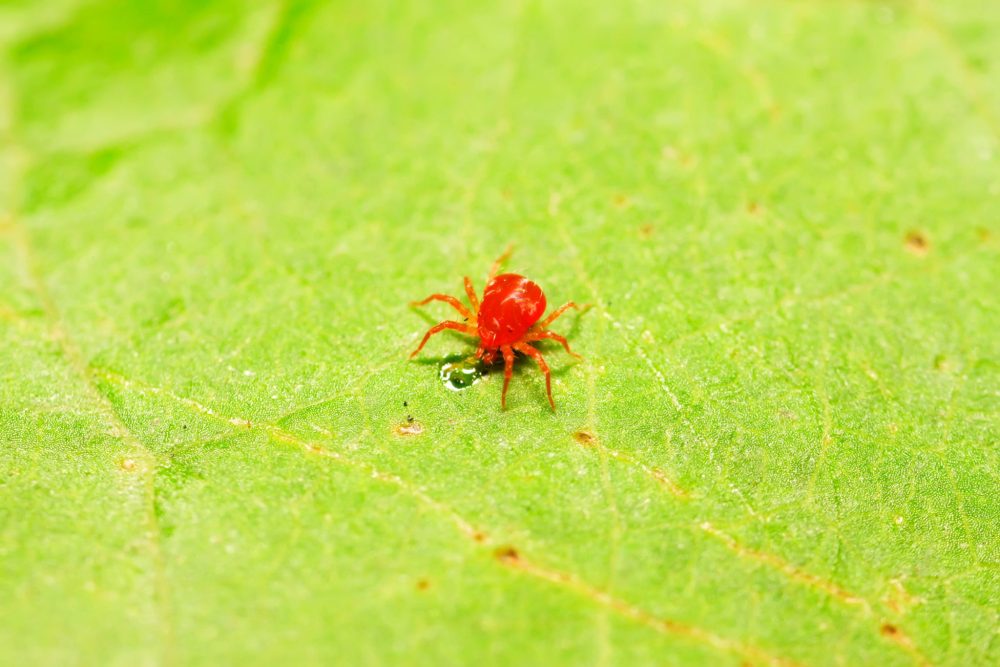
Close up, spider mites are oval-shaped, eight-legged, and are a millimeter long at most (that’s roughly the size of a grain of rice or the tip of a sharpened pencil). They appear in various shades, but mostly rusty orange, red, brown, and yellow. Although they look like the world’s tiniest tick, they cannot harm people or pets, just plants.
When a plant is harboring spidermites, you’ll find flossy webs all across the leaves and plant surface. The spider mites themselves hang out on the bottom of leaves, so you can confirm their presence by checking there.
Spider Mites’ Harm to Plants
Spider mites’ diet is entirely plant-based, and their feeding habits severely damage leaves (and can even kill them) by using their mouthparts to puncture and extract chlorophyll and sap, much like aphids. You’ll know they have made their way to your plants if your leaves have little holes chewed out of them; the holes are usually accompanied by leaves curling or drooping due to the chlorophyll and sap loss.
Usually, spider mites aren’t picky about the leaves they eat; several hundred plant species are at risk of their destructive appetites.
What to do About Spider Mites
Getting rid of spider mites can be tricky. The first thing to do is to manually remove the webs and wash off the bugs as best as you can. Next, you’ll want to use a product that kills any remaining spider mites and prevents them from returning.
They’re not insects, so typical insecticides are usually minimally effective, if at all. If you get a store-bought product, you’ll want something called a “miticide.”
Most plant-safe miticides are made of natural ingredients, including neem oil, a very potent tree oil that you can dilute with water and transfer to a spray bottle. Use the spray to douse your plant’s leaves, stems, top of soil, and all other parts of the plant. Do this once a week and keep the plant in a space isolated from your other plants until you no longer see spider mites or their webs.
Bug Experts in Birmingham
Thanks for reading today’s blog. We hope you are able to free your plant of its spider mite infestation using this information. If your garden or indoor spaces are still being plagued by spider mites, insects (like aphids), or other creepy crawlies, Vulcan Termite & Pest Control is here to help.
For over 40 years, we have gladly served the people of Birmingham and across central Alabama who know they can rely on us to eradicate all traces of pests and implement effective solutions to prevent them from returning. Contact us whenever you have a pest problem, and we’ll be there ASAP to quickly resolve it!
Thanks for reading today’s article from our pest blog! To learn more essential pest control and prevention tips or to discover all the incredible biodiversity Alabama has to offer, check back in here with us every week for fresh new content, or look at past posts to see all the useful pest and critter-related knowledge we’ve shared over the years.